A computer-vision study on using convolutional neural networks to classify medical images: given a chest radiograph, the model decides whether the patient is healthy or affected by COVID-19. The goal was to compare custom and transfer-learning architectures and to show how to train them effectively even with limited (CPU-only) compute.
Dataset
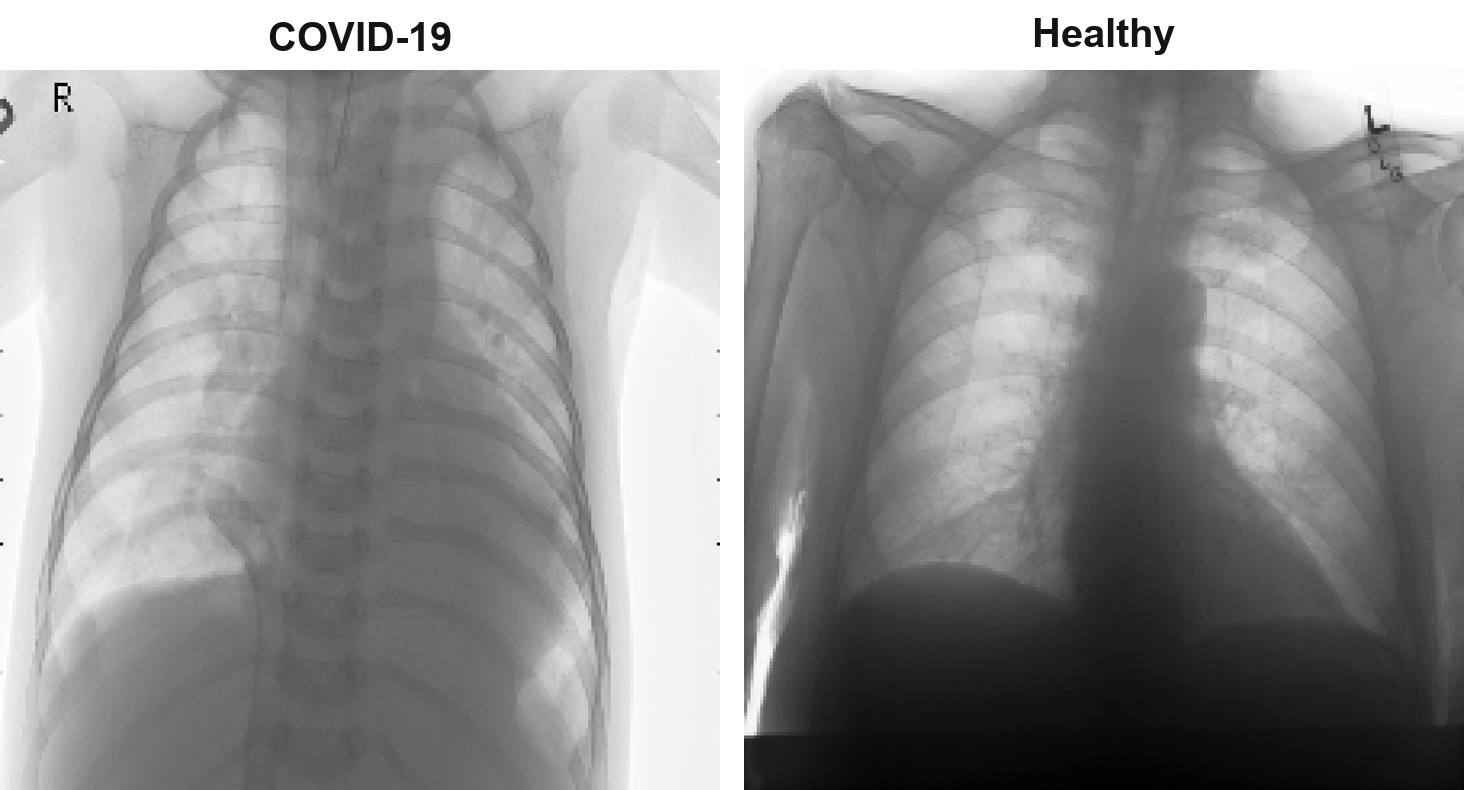
The data comes from a public Kaggle chest X-ray dataset (competition csc532), split into training, validation and test sets, each with two classes — healthy and covid. Every split contains 290 healthy and 118 covid images, so the problem is moderately imbalanced toward the healthy class.
Approach
Four architectures were trained with TensorFlow 2.8 / Keras:
- BasicCNN — a custom network: three convolutional blocks (ReLU + max-pooling),
Flatten, dropout at 50%, and two dense layers (512 and 256 units) before the softmax classifier. - AlexNet — the classic deeper architecture BasicCNN is inspired by.
- ResNet-50 and MobileNetV2 — pretrained on ImageNet and adapted via transfer learning.
To fight overfitting on a relatively small dataset, each image is randomly altered every epoch through data augmentation — random rotation, contrast and zoom — so the model effectively never sees the exact same picture twice.
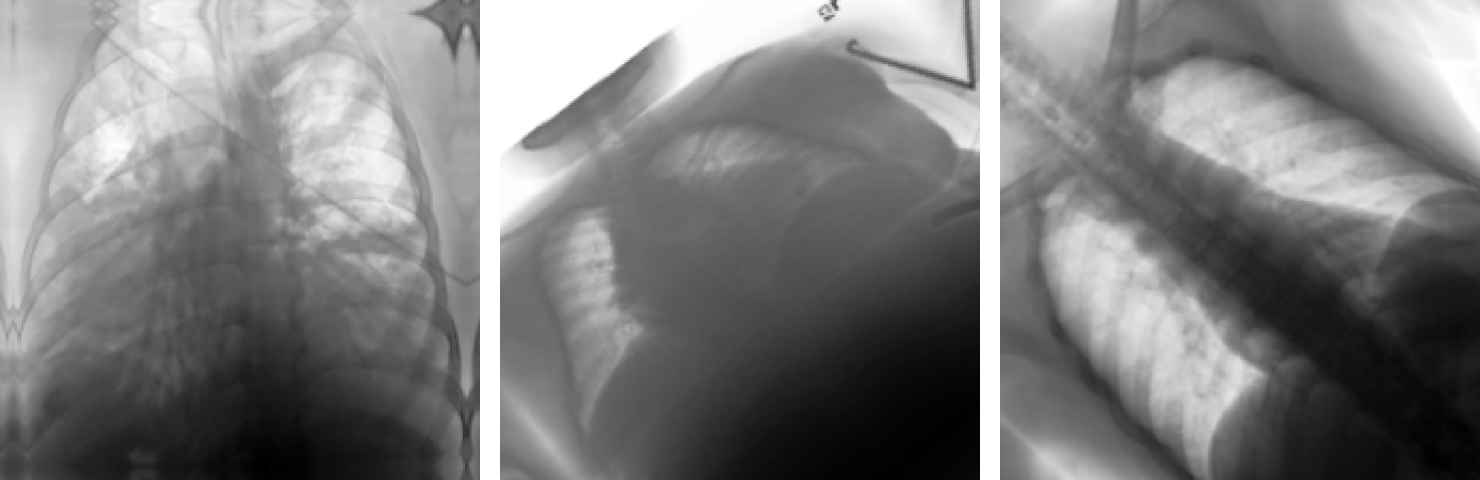
Training ran for up to 100 epochs with early stopping (patience 4 on validation loss), a learning rate of 0.01 and a batch size of 32, entirely on CPU. Models were evaluated with accuracy, precision, recall, F1 and ROC-AUC, plus confusion matrices.
Results
| Network | Test loss | Accuracy | Precision | Recall | F1 | AUC |
|---|---|---|---|---|---|---|
| BasicCNN | 0.2362 | 90.20% | 90.20% | 90.20% | 90.20% | 96.82% |
| AlexNet | 0.2486 | 88.97% | 88.97% | 88.97% | 88.97% | 96.29% |
| ResNet-50 | 0.6032 | 71.08% | 71.08% | 71.08% | 71.08% | 71.08% |
| MobileNetV2 | 0.6154 | 71.08% | 71.08% | 71.08% | 71.08% | 71.08% |
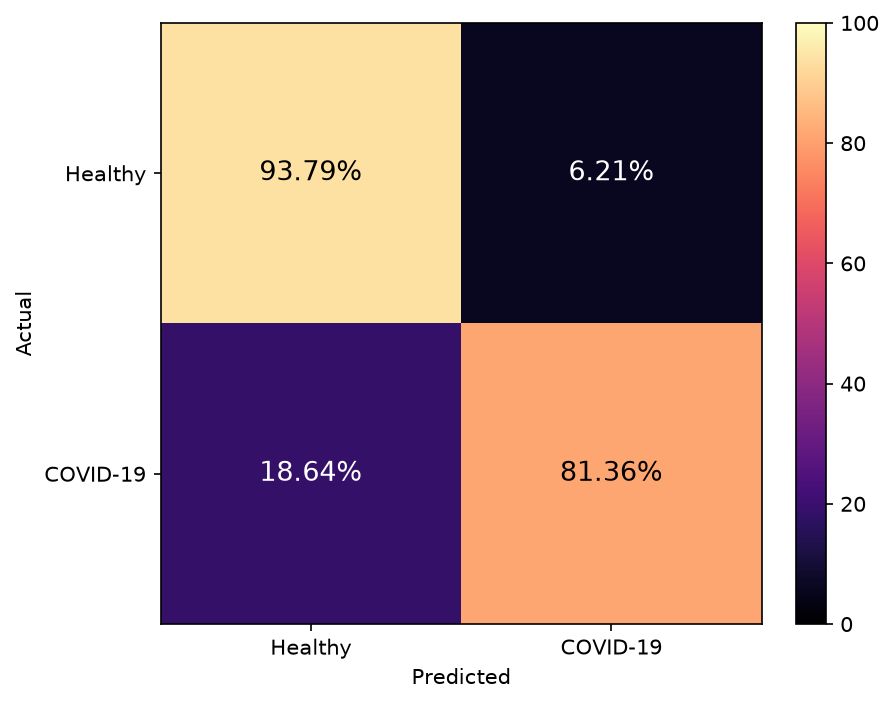
The custom BasicCNN was the clear winner, reaching 90.2% accuracy and 96.8% AUC. The confusion matrix below shows it correctly identifies the vast majority of both classes.
Interestingly, the transfer-learning models (ResNet-50, MobileNetV2) underperformed, collapsing to always predict the majority healthy class (71.08% = the share of healthy images). Two likely reasons: their ImageNet pretraining produces features poorly suited to radiographs, and the limited CPU budget prevented longer fine-tuning.
Conclusions
The experiment confirms that well-shaped CNNs can reach strong accuracy on medical-image classification even without GPUs, and that — for this domain and compute budget — a compact custom network beat much larger pretrained ones. Outlined future improvements include Leaky ReLU activations, replacing some pooling layers with strided convolutions, and training on GPU hardware to close the gap with the top Kaggle leaderboard scores (>92%).