A command-line tool (plus an optional GUI) that recursively searches a keyword inside every PDF in a directory tree. The twist: the same problem is solved with five different concurrency paradigms, so their structure, complexity and performance can be compared head-to-head. Text extraction is handled by Apache PDFBox, and the whole thing runs on the JVM (Windows, Linux, macOS).
The non-functional goals drove the design: scale across cores for low latency, stay responsive via asynchronous models, survive corrupted PDFs without crashing, and keep each paradigm cleanly isolated so new ones can be added without invasive refactoring.
Architecture
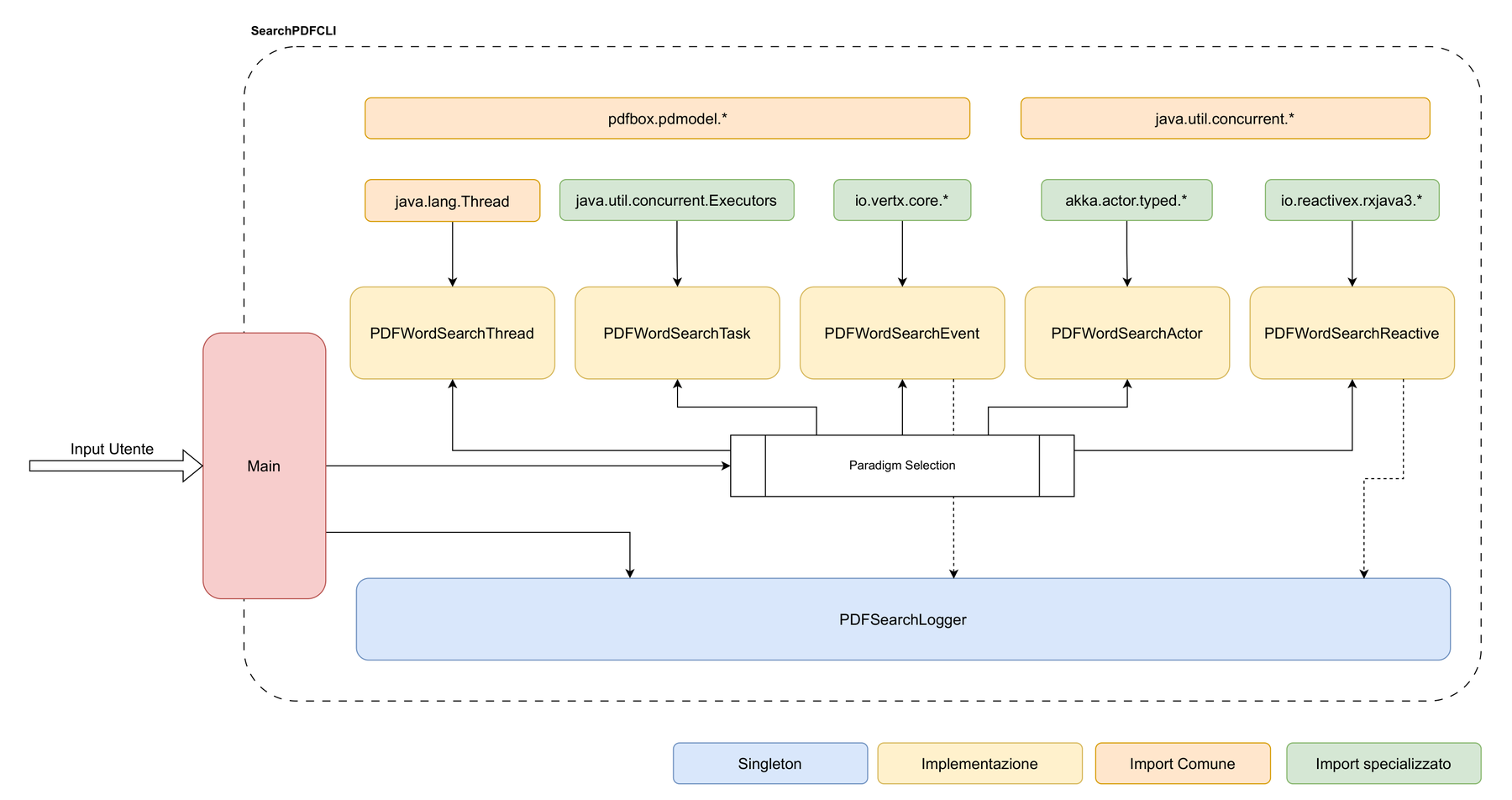
The system is a modular pipeline with a selectable orchestration layer — the concurrency paradigm. A central CLI entry point parses the arguments (root path, keyword, paradigm) and dispatches to the chosen engine through a single switch, while a PDFSearchLogger singleton collects metrics and reports. The functional core is reused unchanged; only the coordination model varies.
Five concurrency paradigms
Each engine implements the same producer/consumer search with a different model:
- Threads — explicit
Threads with a monitor-protected shared queue (ReentrantLock+Condition): a directory scanner produces PDF paths, a pool of workers consumes and matches them. - Task / Executor — an
ExecutorService+CompletionServicepool. - Event-Driven — Vert.x verticles communicating over the EventBus.
- Actors — Akka Typed, with a master actor centralising aggregation (no locks).
- Reactive — RxJava streams with
flatMap(maxConcurrency)for backpressure.
A cross-cutting comparison highlights the trade-offs:
| Aspect | Threads | Task | Event | Actors | Reactive |
|---|---|---|---|---|---|
| Decoupling | Low | Medium | High | High | High |
| Supervision | Manual | Manual | Limited | Native | Operators |
| Backpressure | Manual | Pool size | Custom | Mailbox | Native |
| Extensibility | Medium | Medium | High | High | Very high |
| Debuggability | High | High | Medium | Medium | Medium-low |
| Overhead | Low | Medium | Medium | Medium | Medium-low |
Formal verification with TLA+
The thread-based producer/consumer was specified in TLA+ and checked with the TLC model checker, proving the implementation is free of deadlock and livelock, always terminates after processing every file, never loses a queued file, and keeps shared data consistent. Java components map directly onto the spec (e.g. DirectoryScannerThread → ProduceAndMaybeFinish, the worker pool → Consume, the shared queue → queue).
CLI + GUI
The CLI is the core, packaged as an executable JAR. A separate Swing GUI improves usability when a desktop environment is available, and is deliberately decoupled: it simply launches the CLI as a subprocess for the selected paradigm, so either component can be updated independently.

Performance
The paradigms were benchmarked on a public dataset of 1,076 PDFs (the keyword "research" appears in 195 of them), on an Apple M1 Pro (8 cores). Wall-clock search times:
| Paradigm | Search time (s) |
|---|---|
| Threads | 14.937 |
| Task | 27.392 |
| Event | 17.750 |
| Actors | 14.252 |
| Reactive | 17.434 |
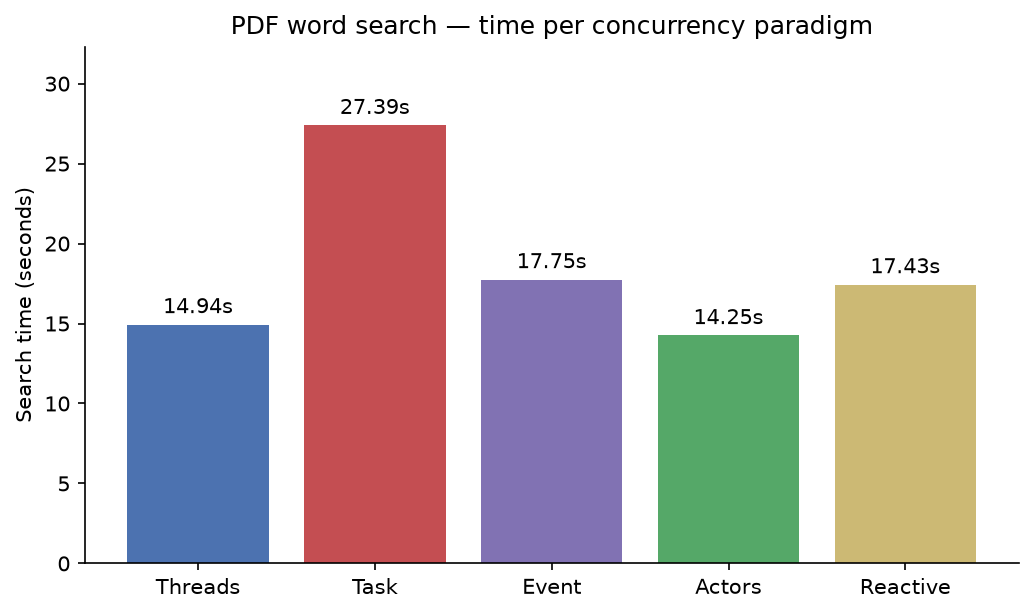
The Actor model came out fastest: its master actor centralises result aggregation, avoiding lock contention, while Akka's dispatcher balances the load well. Threads are a close second thanks to their minimal overhead. The Task model lagged — a sign of sub-optimal pool sizing and dispatch overhead on many small PDFs — while Event and Reactive paid a moderate cost for message marshaling and an initial single-threaded directory scan respectively.
Takeaways
There is no universally "best" paradigm: manual threads stay relevant as a baseline for understanding the fundamentals, tasks are the pragmatic default, Vert.x shines for event-oriented and distributable systems, actors offer the strongest resilience and isolation, and reactive streams give the most composable, backpressure-aware pipelines. Picking one is ultimately a function of the project's goals — performance, resilience, extensibility or sheer simplicity.